
Scorpion Facts, Information, and Photos
- Home
- Scorpion Facts, Information, and Photos
Scorpion Facts, Information, and Photos
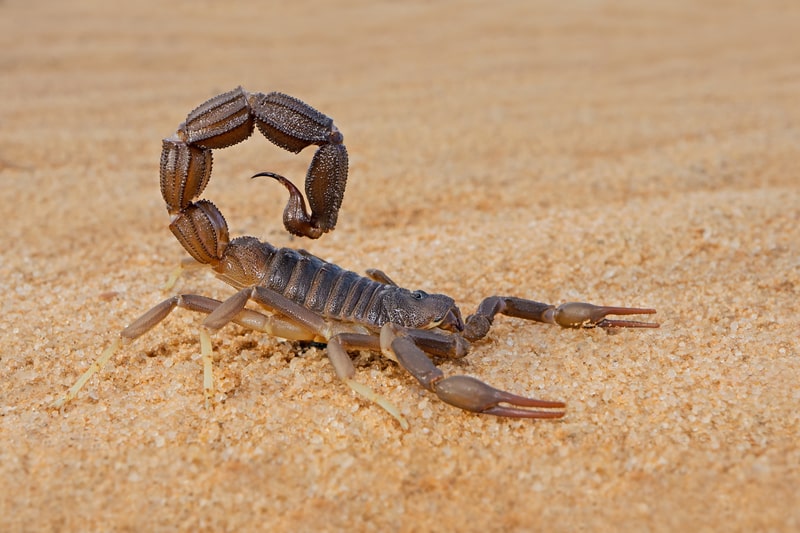

Scorpion Facts
Seeing a scorpion in your home can be alarming. These pests don’t just look scary, they can actually be dangerous.
While scorpions prefer living outdoors, they may sometimes seek shelter in your home. When that happens, you need to make sure they leave your property and never come back again.
In this article, we’ll cover the following commonly asked questions about scorpions, tips for preventing an infestation, and how to get rid of them.
What are scorpions?
Contrary to popular belief, scorpions are not insects. Rather, scorpions are predatory arachnids. Their distant relatives are spiders, mites, and ticks. Like all arachnids, they have eight legs. Although they are classified as arachnids, scorpions are also the oldest known arthropods on the planet. Arachnids are classified beneath the category of arthropods, which are a type of invertebrate creature with an exoskeleton and jointed legs. Historical instances of scorpions date back to the time of the ancient Greeks, including these arachnids as the inspiration for the constellation Scorpio.
Scorpions are commonly found in the southern half of the United States, in both the Southeast and Southwest. Outside of the US, they can be found in parts of South America. While these pests prefer dry desert climates, they often hide in cool, dark places during the day – such as beneath sand and rocks – and hunt by night.
While small (adults are about 2 inches long), these pests are notoriously venomous. A sting from a scorpion can have varying results, ranging from a slight allergic reaction to a fatal outcome depending on the species alongside other factors.
One of the reasons why scorpions can be so difficult to deal with is that they are adept at hiding. You may not know that you have unpleasant neighbors until their occasional visit turns into a full-blown infestation.
Where do you find scorpions?
More than 2,500 species of scorpions exist in the world, including throughout South America, Asia, the Middle East, Africa, and the southern portion of the United States across both coasts.
Scorpions usually live outdoors where food is readily available. They are sensitive to light, so they tend to stay hidden in dark crevices during the day. You can find them under rocks, pieces of bark, and bricks. While a few species can survive in extremely cold climates, most prefer temperatures between 68 and 99 degrees Fahrenheit.
When these pests take shelter in your home, you may discover them in garages, basements, bathrooms, dark drawers, garden plants, and even inside your shoes.
What are the different types of scorpions?
Of the thousands of scorpion species across the globe, approximately 50 of them live in the United States.
Some of the most common types of scorpions you can find in the US are:
- Arizona Hairy Scorpion
- Bark Scorpion (the most venomous scorpion in North America)
- Devil (Stripe-Tailed) Scorpion
- Indian Red Scorpion
The majority of scorpions you may encounter in the US do not pose a lethal threat to humans. However, that doesn’t make an infestation any less unpleasant or dangerous.
Are scorpions poisonous?
Not all scorpions are poisonous to humans. Very few venomous species of scorpions are found in the US. Although Arizona is home to at least 30 different species of scorpions, only the bark scorpion is deemed lethal. The bark scorpion can also be found in parts of California, as well.
Some scorpions can produce venom that can be lethal to small children and the elderly. With timely medical assistance, it’s possible to prevent an unfortunate outcome.
What are scorpion stings?
A scorpion stings by using the stinger, also known as a telson, on the tip of its tail. The stinger has a bulb on the end that terminates in a needle-like protrusion. Venom is created and stored inside the bulb. Each type of scorpion has its own distinct venom and levels of toxicity.
Scorpions respond to a perceived threat by using its stinger, which injects tiny amounts of venom that affect the nervous system.
What happens if a scorpion stings you?
When a scorpion stings you, you could experience a variety of symptoms that range from mild pain to anaphylactic shock. For example, when bitten by a bark scorpion, less than 5% of people experience serious symptoms.
If you are experiencing severe symptoms, you need to seek medical attention immediately.
How common are scorpion stings?
About 1.2 million scorpion stings take place in the world (mostly in Africa and India). Only about 0.27% of them lead to lethal outcomes.
What are the possible complications of a scorpion sting?
Since the venom affects the nervous system, a sting could lead to heart and muscle problems. It could also cause a mild to a severe allergic reaction.
What are the symptoms of a scorpion sting?
The most common symptoms of a scorpion sting are:
- Pain
- Numbness
- Swelling
- Warmth at the site of the sting
Symptoms that indicate a scorpion’s venom has spread systemically include anaphylactic shock, difficulty breathing, heightened blood pressure, sweating, and muscle twitching. If you experience these symptoms, seek medical attention immediately. Children often have a stronger reaction to scorpion venom and should see an emergency physician right away if stung.
Can scorpions kill you?
Deaths as a result of a scorpion sting are extremely rare (0.27%). Of the 1.2 million scorpion stings that happen around the globe each year, fatalities usually happen due to a lack of access to immediate medical treatment.
How are scorpion stings treated?
The Mayo Clinic recommends treating a scorpion sting by first cleaning it with soap and water. To relieve the pain, you can apply a cold compress and take over-the-counter pain relievers. If you observe difficulty swallowing, avoid eating or drinking.
While most adults may not require follow up care, children still need to see a medical professional immediately. Similarly, severe reactions to scorpion stings in both adults and children need to be treated in a hospital setting.